By: Lucy Debenham BA (hons) - Updated: 24 Jul 2023|*Discuss
Q.
I am currently writing my dissertation on the stigma surrounding nail biting and hair twirling, I was wondering if possible could you provide me with any information these aspects of body language reveal about the individual?
(Mrs Katie Rogers, 17 September 2008)
A.
Nail biting and hair twirling are two quite explicit forms of body language. Both nail biting and hair twirling can be either conscious or subconscious body language gestures, each revealing some interesting aspects of the character, emotion and inner workings of the individual.
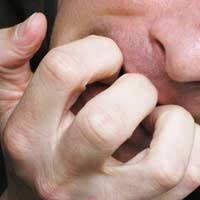
Nail Biting
Nail biting is a non-verbal gesture. In adults it is often a habit that is adopted and carried through from childhood and can become apparent in stressful situations throughout adulthood. To most people, nail biting is associated with nervousness and shyness and is an involuntary response to certain social situations. In many cases, it is an adaptor behaviour that channels nervous energy, inactivity or boredom and does not interfere with normal functioning, the only effect being cosmetic. In severe cases nail biting can become a repetitive behaviour that is intentionally performed. It can result in substantial physical damage.
So when we look deeper, in both adults and children, it has been suggested that severe nail biting is often referred to as a method of ‘self-beating’. This indicates that nail biting is a subconscious behaviour signifying increased anxiety and low self-esteem in the perpetrator. In fact, some have gone as far as to suggest that extensive, frequent nail biting in children can even serve as a cue indicating that child has suffered some level of abuse. However, it’s worth noting that this is not necessarily the view of all psychologists.
Playing With Hair
Playing, twirling, fiddling and hair pulling can be indicative with a number of emotions and behaviours. For instance, children that bite their nails and frequently pull or play with their hair may be nervous or have low self-esteem. Hair twirling may be a comforting action for a child who is tense and anxious, and may become habitual later in life in stressful situations. Routine and severe hair pulling (trichotillomania) can be a compulsive disorder that may be linked to genetics, anxiety, depression and obsessive compulsive disorder. It is most commonly thought to be a stress-related condition.
However, fiddling with hair is also another non-verbal body language that can signify different things in different situations. For example, hair twirling can signify interest and desire. Women in particular are noted for hair twirling when talking to someone that they’re attracted to. It is regarded as flirtatious and preening behaviour, perhaps inviting or inciting the other party to touch their hair. But in other situations, as above, hair twirling can signify anxiety, incompetence, uncertainty or shyness. Why not find out more about how to read body language here?
Related Articles in the 'Ask Our Experts' Category...
I’ve been a hair twirler and nail biter my whole life. I mostly do it bc it feels good. In high school everyone was given a superlative award, and a teacher gave me they award for “most likely to twirl their hair.” In retrospect I find that rude and in edit I’ve, considering others were given things like “most creative” etc… it’s like telling a teenager you’re most likely to smell bad or stutter or whatever. Stupid teachers. Anyways I embrace it as an eff you partly bc of that. I also wear my hair up as an adult every day of my life to minimize chances of me touching my hair so much. More recently, I’ve noticed that at work, whenever I engage in an interesting conversation with coworkers and give them my full attention and focus, I start touching my hair. It’s not so much twirling bc i always wear my hair up, it’s more like I’m stroking my hair roots in the back of my head bc they’re soft and smooth. Most of the time I’m conscious of it but not initially, and then once I realize how annoying it must be to other ppl or how strange i must look with my arm up, I apologize, laugh it offand try to stop. most ppl are nice and don’t mind or think much of it. I like it Bc it feels good so I don’t see it as a huge problem and this don’t have much incentive to stop. I also do it while relaxing at home after I let my hair down. So that leads me to believe it’s not stress or anxiety-related. It’s just a bad habit. It is possible i developed it as a result of trauma/stress or shyness as a child tho, who knows??????? i was a very introverted shy/timid child by nature
ST - 24-Jul @ 12:29 AM
I have a very bad habit of twirling my hair, putting it in my mouth and bitting my hair off. Iv had this habit for about 20 years but only just found out it can be a mental illness, is this true? I already suffer with anxiety and panick attacks
Sue - 18-Sep @ 9:02 PM
I have twisted my hair for years as had my grandmother, mother before me and now my daughter, and my granddaughter.Mostly not aware of doing it.Only do it at home when relaxing.Not really aware of any hair damage.When my hair is short I never twist it, only when the hair gets long.
Pat - 4-Sep @ 7:52 PM
I too am a twirler. I have done it as far back as I can remember and believe I do it just because it feels soooo nice! Mostly it happens when I am relaxing, reading or driving (only when the car is stationary). I am not conscious of starting a twirl - it just happens. Thinking about the cause- when I was 18 months old I was hospitalised in isolation for six weeks and my parents were only allowed to see me through a window. This broke my bond with them and afterwards I would scream if they tried to cuddle me. I think the habit could have come from having to be nice to myself.
Amber - 25-Jan @ 10:24 AM
I've twirled my hair for year's and I have curly hair so I just got in the habit of wrapping the curl around my fingers, that's why I do it.
Lynn - 25-Jan @ 1:39 AM
@Lcd - I do the same thing. It’s awful how much hair I’m losing from the untangling of the knots. I even get headaches from this repetitive action I can’t seem to stop!
T3000 - 10-Dec @ 6:30 AM
I have been twirling my hair for as long as I can remember. I don’t realise I’m doing mostly, and am constantly making tiny notts, which always become completely tangled and result in me ripping out the not. How can I stop this behaviour? I seem to do it without even realising and am worried I will have no hair left
Lcd - 29-Nov @ 12:02 AM
I'm 38 years old and I'm guilty of both nail bite,and hair twirl. I have never been accused of being shy. I do find twirling soothing. And I tend to loop the twist around my forefinger and rub the smooth side of the loop with my thumb..I've caught many people stare at this action with their mouths open as if amazed...but I wasn't cognizant that it could be construed as flirtatious. I also will twist tightly and let the twirl wind in on itself into little knots that stay by themselves near my scalp, then, I attack all smooth sides with all the fingers God gave me! I enjoy it. Driving, at the movies, watching TV....people will take my twist away from me..but they usually laugh at my facial expression and give it back. I will rub it on my cheek,chin, or lips as well. I don't mean to do it..but I don't not mean to either..if that makes sense. I likewise wish I could stop with the nails but just findcomfort in the habit. I was mistreated as a child for thumb sucking. But quit that easily when I got braces at 13.. I'm happy to keep the rest of my habitual quirks. I'm awesome and hope you use some of my details in your dissertation??
Juju - 24-May @ 6:39 PM
I have a similar issue & i've been doing it since i was maybe 4 years old. I twist my hair in little knots in the front or the side of my forehead & press them in between my thumb nail & finger nails...sometime pulling knots out. Ir got worst in my 20's when i would get my hair braided or cornrolled cause i would usually day dream and "finger twist" the tips of my braids through my finger nails. Now that im 33 with no head hair, i found myself doing it with my chin hair & it's getting embarrassing. I do it without thinking and have to usually force myself to stop. It's usually happens when im thinking about something or just casually driving. Any advice on how to stop?
Tjay - 30-Dec @ 8:41 PM
I for years since a child have prickled and jabbed my hair like needles into my lips,edge of eyes,brow and any other sensitive area where i get a sharp prickly feeling.over 30 years ive done this now but feel addicted.is this a nervous problem?it feels satisfying and more so when it gets a spot that feels its going to pierce.This isn't a joke question.i just want to know why i do it.
Miky - 23-Nov @ 9:15 PM
Huh... That's funny. I have always twirled my hair while in deep thought...but never when nervous, anctious, self-conscious or flirting. Wonder what that means.
Treewitch88 - 15-Oct @ 8:12 AM
I love it when my husband grows the top of his hair out but it really bugs me when he keep playing with his hair and he doesn't even know he's doing how do I get him to stop..
hategirl087 - 28-Feb @ 12:12 AM
autumn - Your Question:
I've broken my habit of nail biting, but I still constantly twirl my hair. I also have a habit of rubbing the softest parts against my face and lips unconsciously, it gets a little irritating sometimes because people automatically assume I'm chewing on my hair. Is there any specific reason I feel the need to rub my hair on my lips (I do it at least once every 5 minutes) or a way to stop it?
Our Response:
There are many reasons as to why you might feel the need to do this; it is quite therapeutic which is why it probably becomes a habit. Here are some ideas to help you stop:
Tie up your hair so you can't twirl it
Use a fidget spinner, or squeeze ball etc, to keep your hands busy so you're not tempted
Focus on something else everytime you feel your hands drifting towards your hair - like a colour for example. You can then look for something that colour in the room as a distraction.
BodyLanguageExpert - 27-Feb @ 10:48 AM
I've broken my habit of nail biting, but I still constantly twirl my hair. I also have a habit of rubbing the softest parts against my face and lips unconsciously, it gets a little irritating sometimes because people automatically assume I'm chewing on my hair. Is there any specific reason I feel the need to rub my hair on my lips (I do it at least once every 5 minutes) or a way to stop it?
autumn - 24-Feb @ 3:35 AM
i started twisting my hair at the age of 14 and im 17 now it feels good when i pull at it and all but now i dont know how to not do it in front of people it causes a distraction to people and i feel as though it may interfere with me getting a job .What should i do ?
tt or ty - 26-Nov @ 10:17 PM
I'm 36 years old. I've been biting my nails since I was about 15. My fingers are just disgusting to look at. It super hard to stop now and I bite only when I'm working and I have to think about something. I work in IT so when my fingers are not on my keyboard, they just fly to my mouth. The act is part conscious, part unconscious. The subconscious part happens when my fingers feel each other and they find a nicely shaped long nail. Sometimes I just raise my hand and take a quick look at my nails to see what's chewy on it. That part is almost unconscious.
I don't think your theory applies to me. Maybe I'm the exception to the rule. My self esteem is ok I think. And I don't bite because I'm nervous or anxious or depressed. At my happiest moments I still bite them. Fact is when I'm biting I really enjoy it. It's like bursting bubble wrap or something.
Tiherfru - 3-Oct @ 3:49 PM
Lately, I have started to style my long hair in my sleep, ie I wake up plaiting it or making a bun. What does this mean please?
Lottie - 27-Aug @ 6:57 AM
Chippy - Your Question:
My son had patch of alapicia at start but he then started twirling hair and now has large bald patch down side of head. He also bites his nails. We trying to strengthen hair but while he still twirls I'm not sure this will help. Trying to think what we could get to occupy that twirling hand!
Our Response:
BodyLanguageExpert - 24-May @ 2:17 PM
My son had patch of alapicia at start but he then started twirling hair and now has large bald patch down side of head. He also bites his nails. We trying to strengthen hair but while he still twirls I'm not sure this will help. Trying to think what we could get to occupy that twirling hand!
Chippy - 23-May @ 10:10 AM
Hello :)
My 10yr old daughter bites her nails.
My 5yr old son twirls the crown of his hair.
They are both normal, happy & loved.
She does it when bored. He does it when he's tired or thinking.
I don't do either & my life was full of very difficult events.
Unless you feel it's making your life a misery eg bleeding nails or hair loss - relax! It's ok
Be happy, spend time friends, exercise, smile a lot and look for the joy in every day life.
Good luck everyone :)
Relaxpeeps - 15-Mar @ 11:26 AM
donnabambonna - Your Question:
My little girl has bitten her nails and twirled her hair since she was about 19 months, she started when her little sister was born which will prob link in with stress and anxiety, but she comes across as her confident little girl, I would hate to think she has low self esteem at school, she will be five the middle of March, she has now started pulling at her hair, all of these behaviours seem to be getting a habit, they seem to be more prevalent when she is bored or watching the telly, I bought her a fiddle toy which has helped but do you think getting in touch with the doctor is the next step? I did mention it to the health visitor and she told me to ignore it for her 2 yr check up, x
Our Response:
Try continuing with the confidence building and make sure she has something to keep her hands occupied when she's watching tv etc...such as a doll that she could dres or play with the dolls hair etc. It is quite common for children bite nails and play with their hair (even sucking at the ends of it) at this age, but your GP may be able to reassure you, or establish whether it's an indication of some other problem.
BodyLanguageExpert - 19-Feb @ 10:53 AM
My little girl has bitten her nails and twirled her hair since she was about 19 months, she started when her little sister was born which will prob link in with stress and anxiety, but she comes across as her confident little girl, I would hate to think she has low self esteem at school, she will be five the middle of March, she has now started pulling at her hair, all of these behaviours seem to be getting a habit, they seem to be more prevalent when she is bored or watching the telly, I bought her a fiddle toy which has helped but do you think getting in touch with the doctor is the next step? I did mention it to the health visitor and she told me to ignore it for her 2 yr check up, x
donnabambonna - 18-Feb @ 8:08 AM
I am 18 years old and I have been twirling my hair since I have 5.i use to twirl my hair around my finger until my finger went purple. I stoped for a couple of years then when I started again when I went to high school but this time when I twirl my hair I wasn't happy until I could hear my hair rip.i am still constantly twirling and pull out my hair and it is start to frustrate me
Katy - 18-Feb @ 1:15 AM
I believe since I was in my teens I've been doing this thing with my hair especially with braids in my hair I have this thing to where I braid my hair but then once it's done I would take a braid down and re-braid my hair everytime I can't call it I haveno idea why
Shell - 4-Feb @ 9:54 PM
I play, knot, twist and pull my hair, have done for as long as i remember. I've never been able to stop myself and it's embarrassing if someone sees you. The only thing that stops me when im watching tv is wearing a pair of thin cotton gloves which you can buy from the pharmacy. You can actually get hold of strands of hair and can'tfeel that roughness of your hair so it makes it impossible to do. Try it.
Jay - 28-Jan @ 6:00 PM
Kassie - Your Question:
I have been biting my hair off for a while now. I don't know how to stop. I used to pull out my hair but then stopped when I lost weight because I felt better about myself. I guess having confidence was the key. I later started biting it after I went through a traumatic relationship and I gained the weight back. The nightmare started all over again for me, except this time it was a lot worse. I need help and advice. It makes me feel very sad/depressed and it has gotten worse. Although nobody notices because my hair doesn't look that bad, I don't want it to get bad. My hair grows but I need to stop. Yes, my self-esteem is low, despite the good things people tell me. It was a very hard year in 2015 and I want this year to be the year I stop biting my hair. I want to better my myself and my emotions. I'm tired of letting people and things put me down. I know it's my choice to stop and get better but I can't do it alone. If you can help, please help me.
Our Response:
Ask your GP for help, he/she may be able to refer you for counselling, hypnosis or therapy.
BodyLanguageExpert - 5-Jan @ 10:16 AM
I have been biting my hair off for a while now. I don't know how to stop. I used to pull out my hair but then stopped when I lost weight because I felt better about myself. I guess having confidence was the key. I later started biting it after I went through a traumatic relationship and I gained the weight back. The nightmare started all over again for me, except this time it was a lot worse. I need help and advice. It makes me feel very sad/depressed and it has gotten worse. Although nobody notices because my hair doesn't look that bad, I don't want it to get bad. My hair grows but I need to stop. Yes, my self-esteem is low, despite the good things people tell me. It was a very hard year in 2015 and I want this year to be the year I stop biting my hair. I want to better my myself and my emotions. I'm tired of letting people and things put me down. I know it's my choice to stop and get better but I can't do it alone. If you can help, please help me.
Kassie - 2-Jan @ 10:24 AM
Andrea - Your Question:
I constantly play with my hair, braiding it knotting it and twirling it until my arm is tired. I used to bite my nails really bad but I managed to quit and now I only do it if I'm nervous. I also noticed that I pick at the rubber on my phone case, I've picked off the volume buttons multiple times. I was diagnosed with add a few years ago but I stopped talking the medicine after a month or so. Do you think if I go to the doctor and get on the medicine again this will all get better?
Our Response:
That's for your doctor to advise you on. You could ask about other treatments as well as medicinal, such as hypnosis, coginitive behaviour therapy etc.
BodyLanguageExpert - 14-Dec @ 1:56 PM
I constantly play with my hair, braiding it knotting it and twirling it until my arm is tired. I used to bite my nails really bad but I managed to quit and now I only do it if I'm nervous. I also noticed that I pick at the rubber on my phone case, I've picked off the volume buttons multiple times. I was diagnosed with add a few years ago but I stopped talking the medicine after a month or so... Do you think if I go to the doctor and get on the medicine again this will all get better?
Andrea - 14-Dec @ 12:23 AM
I have twisted, clicked,knotted till I have to cut the knot out.I wish I could stop.
I'm required to ent Re: Body Language of an Abuser
Totally agree with the other poster. And truly, "Perhaps if women were more aware of these indicators, abuse statistics could be…



Re: Changing Gender Roles
Manuscript is a collective name for texts
Re: Asperger's Syndrome and Learning Body Language
I have a son that has Aspergers. I believe in the concept of learning body could help these people. I also…
Re: Body Language Questionnaire: How to Tell If Someone Likes You
I strongly recommend Leonardomitnickhacking@gmail. com to you all. He can help you to…
Re: If a Person Sits on One Leg, What Does This Mean?
No deep psychological reason for using this position. Im 4'10". Hate my legs dangling. It cuts my…
Re: Body Language of an Abuser
Totally agree with the other poster. And truly, "Perhaps if women were more aware of these indicators, abuse statistics could be…
Re: The Role of Body Language in Communication
People do not respond or react towards other people body language. We sometimes take it the wrong way when…
Re: What Do Nail Biting & Hair Twirling Reveal?
I have a very bad habit of twirling my hair, putting it in my mouth and bitting my hair off. Iv had this…
Re: Communication - What Percentage is Body Language?
i have big problem with body language and choice of my words, so i decided to listen first and then…
Re: What Do Nail Biting & Hair Twirling Reveal?
I have twisted my hair for years as had my grandmother, mother before me and now my daughter, and my…
Re: Communication - What Percentage is Body Language?
this sounds interesting and I need tips and tricks of body language. I want to get more informed in…